
Make Believe
My theology of children and reading.

In my job as a children’s minister, I spend a lot of time thinking about children, talking to children, and talking about children. Without children, it is difficult to see the present or the future of the Christian church. We do not always consider including children in conversations but for a congregation to truly flourish, this important group should be considered part of the work that the church is doing and not simply a side activity. Children hold a unique place as stakeholders in the church. Yet, their voices are often not present in decision-making. The very young may not have the ability to advocate for themselves or the experience to know what they might need. It is paramount that adults take seriously children’s concerns and create spaces of wonder and exploration for children to engage in spiritual practices.
Additionally, children have an important voice and perspective in our faith conversations. We must resist the urge to see children as simply vessels into which we pour our values, and instead see them as conversation partners from whom we can learn. Children can offer a fresh perspective on scripture and tradition as well as a view of the world that is different from adults but equally as valid. Rather than holding them at a distance, we should view them as important and meaningful conversation partners and participants in our communities.
We must take children seriously as people with opinions and experiences that matter. I find that to be the most important part of my job: to take children seriously, to recruit volunteers that take children seriously, and to plan activities that take children seriously.
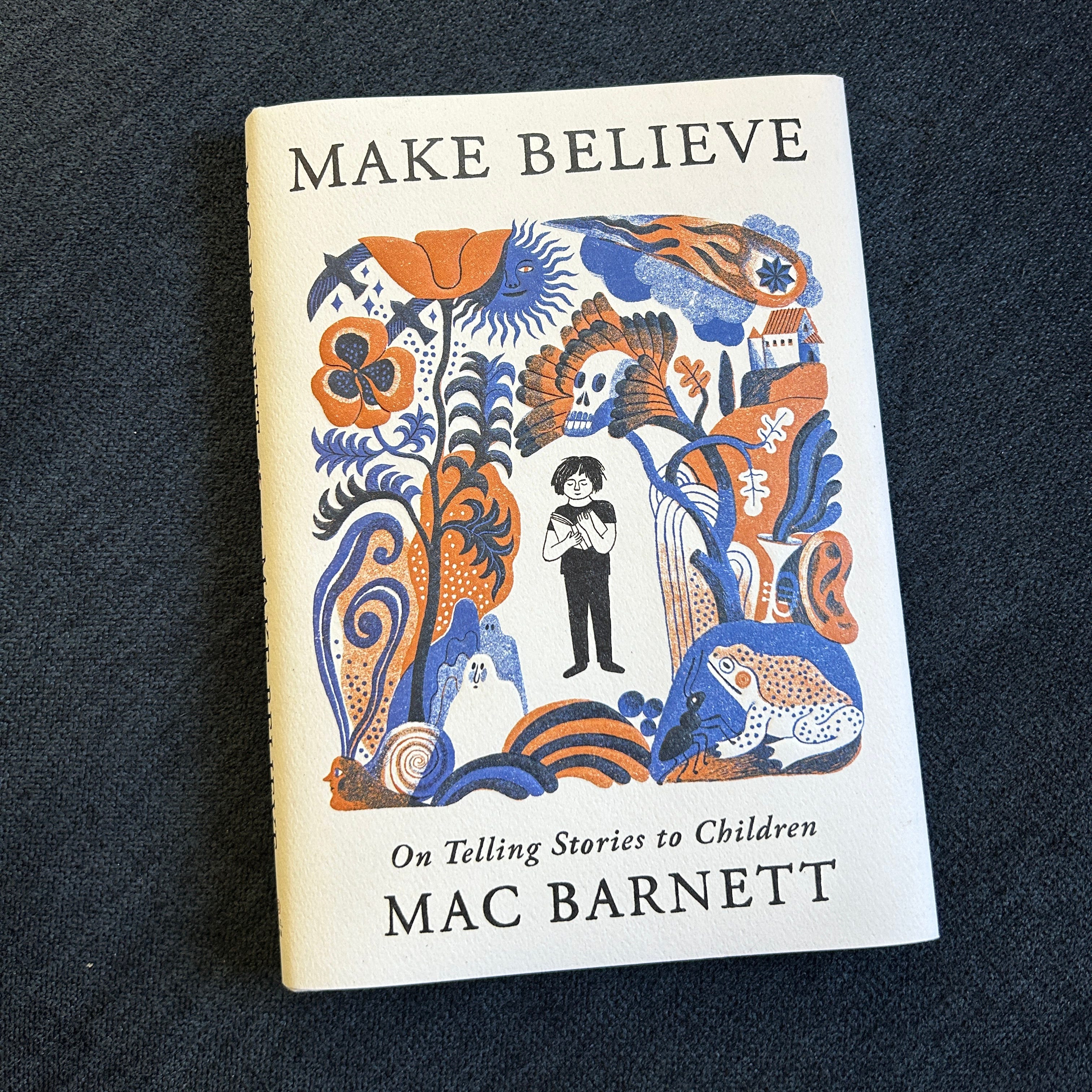
This week, like many many people who care about children and children’s literature, I read Mac Barnett’s book Make Believe: On Telling Stories to Children. We are big Mac Barnett fans in our house. When I worked as a librarian, the kids all knew that his book Sam and Dave Dig a Hole is my favorite read-aloud of all time. Barnett’s daily book club sustained my family during the pandemic. His books are funny and subversive and I enjoy sharing them with kids. At the same time, I don’t use his books all that much in church spaces. It has been clear to me that he doesn’t particularly like the idea of using books the way that I like to use them in church. His emphasis is on books as art, and books as entertainment.
In the picture book proclamation that Barnett and others created several years ago, they said a lot of things that I agree with: Children’s books merit grown-up conversation. The tidy ending is often dishonest. Every day we make new children—let us make new children’s books. At the same time, there is one line that has always irked me a bit and that is: The line between moral and meaning is paramount. For one thing, I am not totally sure that I know what it is intended to mean. And for another thing, I do believe that sharing values via books is important and valid.
Do I like celebrity picture books? No, I do not. I am allergic to many rhyming books because the language feels forced. I am not a fan of any books, especially religious books, that are simply used to tell kids how to act.
At the same time, I appreciate how some SEL books are able to be used in schools - by teachers, librarians, and counselors - to help kids understand their feelings, their friends, and their social landscape. There are books that are didactic that are more subtle than others, and many of them are useful for conveying our values. I love a picture book biography that opens up the world and does teach children about people and experiences beyond what they know. Children already think deeply about justice, experience injustice, and have important questions about the world. Books are an excellent resource for these conversations.
I agreed with what I read in Make Believe about taking children seriously, taking children’s literature seriously, and keeping children (and not adults) at the center of children’s publishing. I have, many times, read a book for kids and thought, I love this but it is too long for the kids I think might like it, or I love this but what kid would enjoy it? I think many adults do get into a trap of thinking about what kids ought to read rather than making/finding/enjoying the best books that kids want to read.
Our parallel situation in the church is that we need to make sure that church is a place where kids feel welcome as their whole (messy) (noisy) (anxious) (neurodivergent) selves rather than expecting them to be just like those of us who have done our best to squash the noise and the mess and the anxiety out of public view. This year, I am part of a group of churches that is working to consider how best to welcome and celebrate children in corporate worship spaces, and I am excited to think about the ways that this allows children to be not only present in worship but leaders in our worship spaces and services.
Where I felt that Mac Barnett and I might diverge, based on Make Believe, is that I felt that he primarily sees books as a place of wonder and of play. And I love that, too. When I worked at the Episcopal school, one of my favorite days of the year was when I would read Press Here to the PreK students and they would ask, “Is this book magic?” Reading The Book With No Pictures to a kid for the first time is an unparalleled experience. During COVID read-alouds, I had parents message me that they had the best time listening to their kids scream at me (and the book) when I read Sam and Dave Dig a Hole to them. I treasure all of those memories.
I also treasure the many times I have read The Man Who Walked Between the Towers to groups, listening to them gasp at the adventure while learning part of our history. I love reading Miracle Man to kids and talking about the little girl who shared her food with Jesus. I will never forget the times I read Giant Squid to kids and they were in awe of this amazing and mysterious creature. Or the time I read The Youngest Marcher and a young girl asked, “Why didn’t the cops help them?”
I love to be silly with kids, and to use books to do that. I do also read picture books to kids because I want to share my values with them. Some of those values are kindness and generosity (the fruit of the spirit). I want them to wonder about the world. I want us to laugh together. I want them to know that our community believes in a creative God, and follows a God who told stories (some without tidy endings). I want them to be holy troublemakers.
I do not read books to kids because I am trying to Make Them Believe. (Sometimes I don’t even know what I believe!) I don’t want to indoctrinate our children (and, knowing our children, that would be a difficult task - they are bright and challenging and not easily convinced). I want the children in our care to know they can Make Their Own Belief in the world, and I hope I am offering them a view of the world that welcomes them as they are, takes seriously their questions and concerns, and sees their formation as an important work of the church, not simply a messy craft and a break for the parents.
I Believe we can take children seriously and empower them as moral thinkers while also offering them our values, and I believe we can do that without being boringly didactic. That is what I try to do when I spend time with kids: to listen to them, to validate their questions and experiences, and to offer them ideas about how they can make their way through the world. To me, books are one of the safest ways to learn. I read stories to children to welcome them into a community that believes in their power and agency to change the world. I also read stories to children so I can hear what they notice, think, and understand that I might have missed.
I left Make Believe feeling slightly unsatisfied, and after a couple of days I think I can articulate why. Barnett feels strongly about not indoctrinating children, which I understand and agree with, but he misses, for me, that joy of connecting with kids about not only play but about our deepest selves. I could not make sense of the world without these children and their questions, and I certainly could not make my own belief without their input. They are, quite simply, the great joy of my life. Taking them seriously is foundational work. Far be it from me to (even try to) Make Them Believe anything.
As I am not a children’s writer and I do not work as a librarian anymore, I am not attempting to wade into the larger discussion about Barnett’s comments about crud. Writing a picture book seems incredibly difficult, a high wire balancing act that I know I personally could never attempt. There are certainly some children’s books I don’t think are very good (see: most celebrity picture books), but I encounter many lovely and wonderful books and those are the ones I would rather focus on. I wish that he would have done that, too, and I think that we should listen to his colleagues who are wounded by his remarks. I found this substack post by Afoma Umesi to be a fair and accurate reading of the situation.